
Author
Michael Benson
CEO of Cubes.Co
Why Standard Offices Limit Creative Agencies
Creative agencies do not work in a straight line. A campaign can move from a quiet strategy session to a high-energy brainstorm, a client presentation, a content shoot and a focused production sprint in the same day.
Standard offices are rarely built for that rhythm.
They typically prioritise uniform desks, fixed meeting rooms and predictable headcount. That may suit repetitive workflows, but it can limit the way creative teams exchange ideas, express their brand, concentrate and produce work.
The right creative agency office space should do more than house a team. It should act as part studio, part collaboration engine, part client experience and part cultural home. When the space can adapt to the work, the agency gains room to create, pitch and grow without being boxed in by a rigid lease or fitout.
The short answer
Standard offices can limit creative agencies because they often lack:
- A useful mix of collaborative, private and production-ready spaces
- Flexibility to reconfigure as projects and teams change
- Acoustic separation for focused work, calls and editing
- Strong visual identity and an environment clients remember
- Infrastructure for photography, video, podcasting or content reviews
- Breakout areas that support spontaneous discussion
- Flexible commercial terms that match changing headcount
For an agency, the issue is not simply whether an office looks good. The real test is whether it supports the full creative workflow.
1. Standard layouts can flatten collaboration
Creative collaboration is rarely confined to a scheduled meeting. Ideas emerge while reviewing work on a screen, sketching a concept, comparing references or pulling the right specialist into a conversation.
A conventional office built around rows of desks and enclosed boardrooms creates only two settings: sit quietly or book a formal meeting. The valuable middle ground is often missing.
Effective office design for creatives should provide a range of settings, including:
- Open project tables for active work
- Informal lounges for quick discussions
- Writable walls or presentation surfaces
- Small rooms for two-to-four-person reviews
- Larger rooms for workshops and client presentations
- Digital screens that make work visible and easy to critique
This variety matters because creative work moves between different modes. Gensler’s Global Workplace Survey, based on more than 16,800 office workers across 15 countries, reinforces the need for workplaces that support both individual and collective work. One room type cannot carry the entire creative process.
The office should work like a strong campaign team: different roles, working together, each built for a specific moment.
2. Generic space weakens brand expression
An agency’s office is a physical expression of its thinking. Clients form an impression before the first slide appears on screen.
Generic interiors, fixed signage rules and bland reception areas can make a distinctive agency feel interchangeable. That disconnect matters when the business sells imagination, taste and strategic originality.
Strong creative environment design gives an agency ways to bring its identity to life through:
- Brand colours, graphics and signage
- Curated artwork and campaign work
- Furniture that reflects the agency’s personality
- Flexible presentation and showcase areas
- Lighting suited to the mood and type of work
- Arrival spaces that create a memorable client experience
The goal is not decoration for decoration’s sake. It is alignment. A strategically designed workspace can show clients how the agency thinks, help employees feel connected to the brand and give prospective talent a reason to want to join.
In a flexible workspace, ask what can be personalised inside the private office or team room. A high-quality operator should help you build identity without forcing you to carry the full cost and complexity of a traditional fitout.
3. Open-plan noise can undermine focused creative work
Agencies need energy, but energy without control becomes distraction.
Copywriting, editing, design refinement, media planning and strategic thinking all require concentration. A team cannot deliver its best work if every call, conversation and coffee run competes for attention.
Recent Leesman workplace data shows the size of the problem. Its 2026 analysis of office noise reports that 89% of employees consider individual focus work important. Noise levels matter to 70%, yet only 35% are satisfied with them. The research also identifies significant gaps in perceived productivity and wellbeing between people who are satisfied with workplace noise and those who are not.
The answer is not to isolate everyone behind closed doors. It is to provide choice.
Look for creative agency office space with:
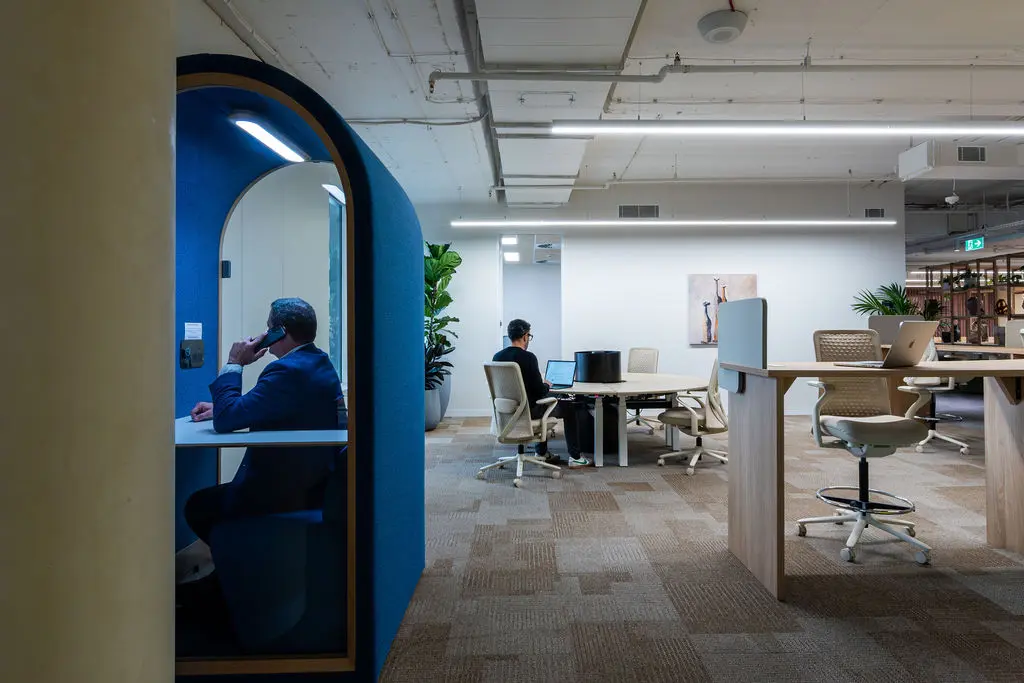
- Acoustically treated private offices
- Quiet zones for deep work
- Phone booths for calls and voice notes
- Enclosed rooms for client conversations
- Collaboration zones positioned away from focus areas
- Soft finishes, partitions and layout features that control sound
The best creative workspace can be energetic at 10 am and deeply focused at 2 pm. Both modes need a home.
4. Standard offices rarely meet production requirements
Modern agencies are increasingly content businesses. Even teams that do not identify as production studios may regularly record podcasts, shoot social content, capture product photography, host webinars or edit video.
Standard office specifications usually stop at desks, meeting rooms and internet access. That leaves agencies improvising shoots in boardrooms, battling poor acoustics, moving furniture or hiring external studios every time content is required.
When assessing studio space requirements, consider:
- Natural and controllable lighting
- Acoustic performance
- Reliable, high-speed internet for large file transfers and live content
- Adequate power and accessible outlets
- Space for cameras, lighting, backdrops and crew movement
- Secure equipment storage
- Furniture that can be moved quickly
- Bookable photography, video, podcast or event facilities
- Loading and after-hours access where relevant
Not every agency needs a permanent studio. Many need reliable access to one. This is where flexible workspace solutions can create a commercial advantage: use specialist facilities when required without paying for dormant production space every day.
corporatecubes.co/ offers access to premium offices, meeting rooms and studio hire options across its wider workspace network, allowing teams to match the space to the task.
5. Fixed offices struggle with project-based headcount
Agency resourcing changes quickly. A pitch may bring in freelancers for six weeks. A major account can add a new team. A retained client may reduce scope. Project rooms can be busy one month and quiet the next.
A long lease and fixed fitout make every headcount change expensive. Too little space constrains delivery. Too much space turns unused desks into overhead.
Flexible workspace solutions allow agencies to respond with less friction through:
- Private offices and team rooms in different sizes
- Shorter, more adaptable commercial terms
- Project space for temporary teams
- Day offices and business lounge access
- Meeting rooms available when required
- The ability to expand within a broader workspace network
That flexibility protects cash and keeps the workspace aligned with the current brief. Think of it like an agency bench: strong enough to support the core team, with the ability to bring in extra capability when the match demands it.
6. Conventional meeting rooms can restrict client experience
Client work is not one-size-fits-all. A credentials presentation needs polish. A workshop needs movement and participation. A difficult feedback session needs privacy. A campaign launch may need event capability, hospitality and production support.
A standard boardroom is not automatically equipped for all four.
Creative agencies should prioritise access to:
- Professional boardrooms for senior meetings
- Workshop rooms with flexible layouts
- Large displays and simple presentation technology
- Video conferencing that works without a technical rescue mission
- Informal spaces for relationship-building
- Event spaces for launches, panels and community gatherings
- Hospitality support that makes the client experience feel considered
corporatecubes.co/ provides bookable meeting rooms and a national Business Lounge network, helping teams meet, present and work beyond the boundaries of a single fixed office.
7. Poor workspace choice can dilute agency culture
Culture is not created by furniture, but space can either support it or work against it.
Agencies build momentum through shared rituals: work-in-progress reviews, informal mentoring, team lunches, spontaneous problem-solving and celebrating a win together. A sterile office with nowhere to gather can make those moments feel forced. A noisy space with no privacy can make people avoid it altogether.
The strongest workspace creates reasons to come together while respecting that different people and tasks require different environments. Look for shared spaces, community activity, food and beverage options, event programming and teams that actively manage the member experience.
Community can also widen an agency’s commercial world. Working alongside businesses from different sectors creates opportunities for introductions, partnerships, referrals and fresh perspectives. Good ideas rarely improve by staying inside one room.
What to prioritise in a flexible creative workspace
Before committing, assess the space against the way your agency actually works.
1. A mix of work settings
Confirm that the workspace supports quiet focus, informal collaboration, formal meetings, private calls and team-wide sessions. Variety is more valuable than a sea of identical desks.
2. Acoustic control
Visit during a busy period. Test whether conversations carry, phone booths are available and quiet areas remain genuinely quiet.
3. Production capability
Map your content workflow. If you shoot, record, stream or edit, inspect the lighting, sound, power, internet and equipment access rather than relying on a generic facilities list.
4. Brand flexibility
Ask what you can customise inside your office, at reception and in client-facing areas. Your workspace should strengthen your identity, not erase it.
5. Technology that disappears into the background
Fast, secure internet, presentation screens, room booking and video conferencing should work smoothly. Technology should support the idea, not become the meeting.
6. Room to scale
Understand how easily you can add desks, take project space or move into a larger office. Ask what happens if headcount moves in either direction.
7. Client-ready facilities
Review the arrival experience, meeting rooms, hospitality, accessibility and on-site support. Your client should feel confident from the moment they enter.
8. Location and network access
Consider transport, nearby amenity and whether your team can access other locations. Multi-site access can support distributed teams, client meetings and interstate production.
Explore corporatecubes.co/ locations across Australia.
A practical checklist for agency leaders
Ask these questions during every workspace tour:
- Can our team move between collaboration and focused work without disruption?
- Is there enough acoustic privacy for calls, editing and confidential client work?
- Can we display our brand and creative output?
- Are the meeting rooms suited to workshops as well as presentations?
- Can we access studio or event space when a project requires it?
- Is the internet suitable for large files, cloud workflows and live production?
- Can the office expand or contract with our pipeline?
- Are there spaces where the team will genuinely want to gather?
- Does the environment create the right impression for clients and talent?
- What support is available when a room, event or piece of technology needs attention?
If the space only answers the desk-count question, it is not solving the agency’s full workspace challenge.
Build a workspace around the work
Creative agencies need more than a conventional office with a more colourful couch. They need an environment that can move with ideas, people, projects and clients.
The right creative agency office space balances energy with focus, individuality with professional presentation, and flexibility with operational reliability. It gives the team room to think, make, meet and grow while reducing the commitment and complexity of a traditional lease.
corporatecubes.co/ delivers premium, flexible workspaces supported by meeting rooms, shared amenities, hospitality and a connected business community. Whether your agency needs a private office, project room, production access or a wider national footprint, the space can be shaped around the way your team performs.
Ready to find a workspace that works as creatively as your agency does? Book a tour or enquire with corporatecubes.co/.
Frequently asked questions
What is creative agency office space?
Creative agency office space is a workplace designed to support the varied activities of agency teams, including focused work, collaboration, client presentations, content production and project-based growth. It typically combines private offices with meeting rooms, breakout areas, quiet zones and access to specialist facilities.
Why are standard offices unsuitable for some creative agencies?
Standard offices often rely on fixed layouts, uniform desks and conventional meeting rooms. These settings may not provide the acoustic control, adaptable collaboration areas, production capability or brand flexibility that creative agencies require.
What should a creative agency look for in an office?
Prioritise a mix of work settings, strong acoustics, reliable technology, bookable meeting rooms, production access, brand customisation, flexible terms and room to scale. The best choice should support both creative output and commercial operations.
How does office design affect creativity?
Office design influences how easily people can exchange ideas, concentrate, review work and shift between different tasks. A well-designed creative environment provides choice rather than forcing every activity into the same setting.
Do creative agencies need their own studio?
Not always. Agencies with frequent or highly specialised production may benefit from dedicated studio space. Others can reduce overhead by choosing a workspace with bookable photography, video, podcast or event facilities available when required.
Can a flexible workspace support confidential client work?
Yes, provided it includes secure private offices, enclosed meeting rooms, acoustic privacy, reliable network infrastructure and appropriate access controls. Agencies should inspect these features directly before committing.
Is coworking suitable for a growing creative agency?
Coworking can suit a growing agency when it offers private team space alongside shared amenities. This model gives the agency a secure base while providing flexible access to meeting rooms, lounges, community events and additional space as the team changes.
How can flexible workspace reduce agency overhead?
Flexible workspace can bundle furniture, internet, utilities, cleaning, meeting facilities and on-site support into one arrangement. It can also reduce upfront fitout costs and the risk of paying for more space than the agency currently needs.