

Author
Michael Benson
CEO of Cubes.Co
Private Offices for Growing Companies
Growth changes what a business needs from its office. More people join. Client meetings become more frequent. Hybrid schedules shift. The space that worked six months ago starts creating friction.
For professional services firms, finding the right office means balancing confidential work, a polished client experience and room to grow. It also means giving employees somewhere they can concentrate, collaborate and feel supported.
The best private offices for growing companies bring these requirements together: dedicated space for your team, access to useful shared amenities and clear options when your needs change.
This guide explains what flexible private offices offer, how to compare them and what to check before making a commitment.
What is a flexible private office?
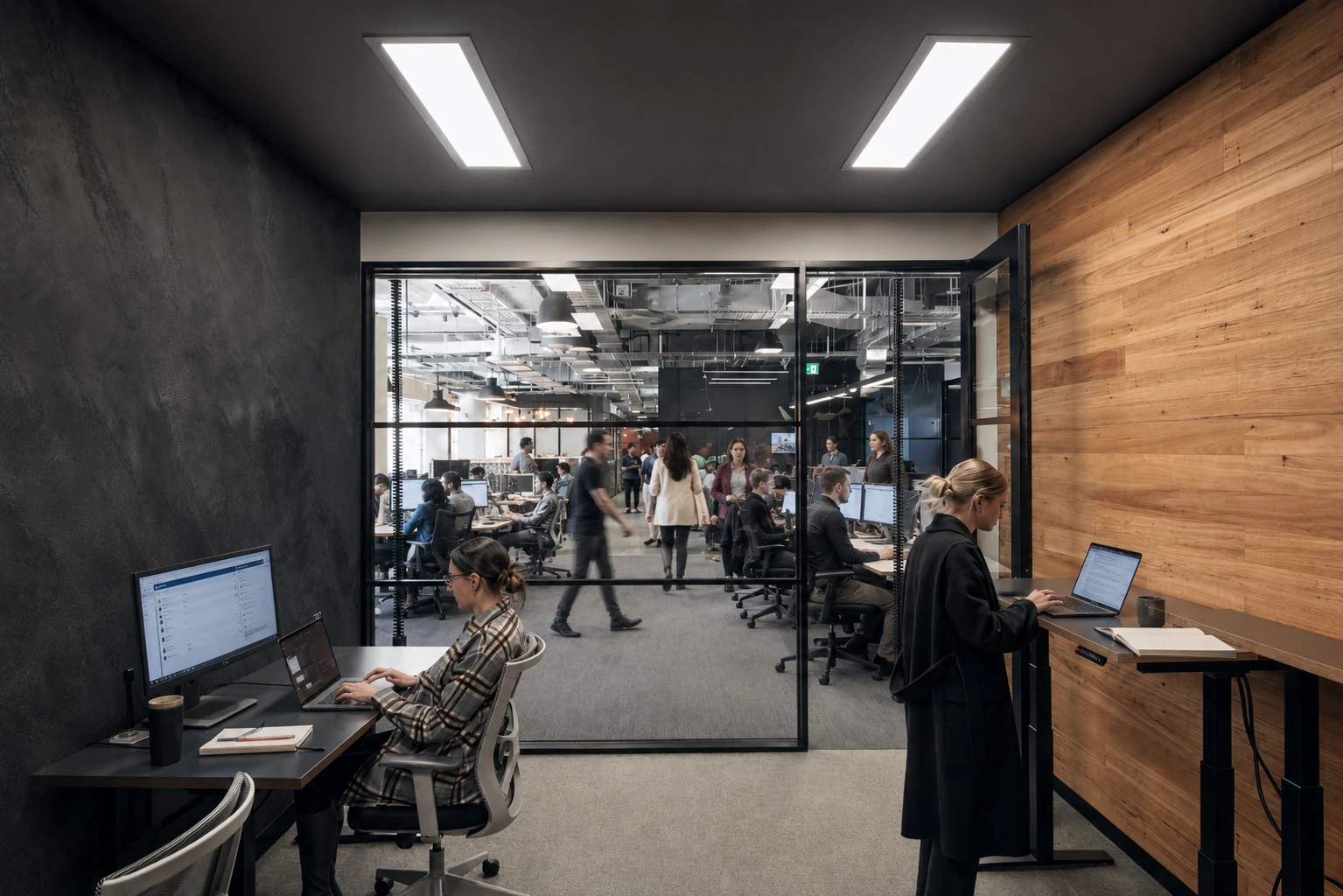
A flexible private office is an enclosed workspace reserved for your business within a managed workplace. Your team has its own office, while facilities such as kitchens, lounges and meeting rooms may be shared with other businesses.
Many serviced arrangements combine furniture, internet, utilities and workplace support into a regular fee. Inclusions, access hours and minimum terms vary between providers and packages.
Flexibility can mean a choice of agreement lengths, different attendance packages or the ability to move into another office as your team changes. Each option needs to be confirmed in the agreement.
For office managers, the appeal is practical: a professional base with fewer separate facilities tasks to coordinate.
How do flexible private offices compare with other options?
| Workspace option | How it works | Key consideration |
|---|---|---|
| Flexible private office | A dedicated enclosed office within a managed workplace | Check privacy, included services and terms for changing space |
| Open coworking membership | Access to desks in a shared working area | Assess suitability for confidential calls and concentrated work |
| Conventional leased office | Premises occupied under a negotiated lease, with responsibilities set by its terms | Allow for setup, ongoing management and future space requirements |
| Bookable day office | Private workspace reserved for particular days | Check repeat availability, storage and access between bookings |
A conventional office can suit a firm that needs extensive customisation and has stable space requirements. Flexible office space can suit a business that values a ready-to-use environment and greater choice as its needs evolve.
The right decision depends on how your team works and what the proposed arrangement actually provides.
1. Evaluate privacy beyond the office door
For accountants, consultants, recruiters and advisory teams, privacy is a daily operational requirement. An enclosed room is a starting point, but it does not tell you how well the space handles confidential work.
Check acoustic and visual privacy
During a tour, ask to assess the office while neighbouring spaces are occupied. Consider whether conversations carry through walls, doors or adjoining rooms.
Check sightlines from corridors and shared areas. Screens, whiteboards and client documents should be positioned away from passing visitors.
Useful questions include:
- Can ordinary conversations be heard outside the office?
- Are there suitable rooms for sensitive calls and client discussions?
- Can blinds, screens or approved layout changes improve visual privacy?
- Is secure storage available for documents and equipment?
Understand access and technology arrangements
Ask how office access is managed, how visitors are received and who can enter your workspace for cleaning or maintenance.
Have your IT team review connectivity, network separation and any requirements for dedicated infrastructure. A description such as “business-grade internet” does not answer every security or performance question.
The goal is to make privacy and shared amenities work together without relying on assumptions about either.
2. Look for a clear pathway to scale
Scalable workspace is only useful when you understand how changes happen.
Ask what would happen if your firm hired three people, secured a major project or needed a smaller footprint at renewal. Find out whether changes involve a new agreement, additional fees or a different location.
Before choosing an office, confirm:
- The notice required to request a larger or smaller space.
- Whether changes are permitted during the initial term.
- How pricing and deposits change when you move.
- Whether suitable offices are available within the building or wider network.
- What happens if your preferred space is unavailable.
A provider may offer multiple office sizes, but that does not guarantee a larger room will be vacant when you need it.
Plan around attendance as well as headcount
An eight-person firm does not necessarily need eight desks every day. Equally, choosing space around average attendance can leave the team crowded on its busiest days.
Map normal attendance, peak attendance and planned hiring. Include visitors, equipment and employees who need permanent workstations.
For example, a consultancy might need a dedicated team office for everyday work and a larger bookable room for monthly planning sessions. Test the availability and total cost of that arrangement before committing.
3. Assess the employee experience in practice
A polished reception creates a strong first impression. The working day reveals whether the office supports your people.
Ask employees what they need to do their best work. Common priorities include comfortable furniture, manageable noise, reliable video calls and convenient transport.
On a tour, assess:
- Focus: Can employees work without constant interruptions?
- Comfort: Are lighting, ventilation, desk space and seating suitable?
- Collaboration: Is there somewhere to talk without disrupting colleagues?
- Breaks: Are kitchens, lounges and outdoor areas practical and accessible?
- Access: Does the journey work for your team and visiting clients?
- Support: Who resolves workplace issues, and when are they available?
Invite a small group of employees to visit shortlisted spaces. Their feedback can reveal practical issues that photographs and floor plans miss.
A strong employee experience comes from removing everyday friction. The office should make a busy working day easier to manage.
4. Separate access to amenities from included usage
Shared amenities can give smaller firms access to facilities they would otherwise need to fund and manage themselves. Their value depends on availability, quality and the way charges work.
Meeting rooms and boardrooms
Professional services offices often need rooms for interviews, client presentations and confidential discussions.
Ask whether meeting room usage is included, credit-based or charged separately. Check peak-time availability, cancellation rules and the equipment provided.
A boardroom in the building is useful only if you can book it when your clients need it.
Reception and client arrival
Walk through the experience as a visitor. Check how guests find the building, receive directions, announce their arrival and reach the meeting room.
Confirm reception hours and how appointments work outside those hours. If your firm needs telephone answering, mail handling or administrative assistance, clarify which services are available and their charges.
Lounges, kitchens and workplace facilities
Consider how shared spaces complement your private office. A lounge may suit informal conversations, while a meeting room provides a more controlled setting for client work.
Check cleaning standards, seating availability and any additional costs for printing, refreshments, lockers or end-of-trip facilities.
5. Compare the full cost of occupancy
When comparing SME office solutions, the advertised monthly fee is only one part of the decision.
Request an itemised proposal based on your expected usage. Separate recurring fees, variable charges and upfront payments so you can compare options consistently.
| Cost category | What to confirm |
|---|---|
| Office fee | Capacity, included services and treatment of GST |
| Upfront payments | Deposit or bond, setup fees and payment timing |
| Meeting facilities | Included credits, hourly rates and likely monthly usage |
| Technology | Standard connectivity and any dedicated requirements |
| Operational extras | Printing, administrative support, parking and storage |
| Changes and departure | Relocation fees, notice requirements and exit charges |
Build a normal-use scenario and a busy-month scenario. This shows how the arrangement performs when client meetings, attendance or project activity increase.
When comparing with a conventional office, include applicable fitout, furniture, utilities, cleaning, maintenance and internal administration costs. Flexible space may reduce setup work, but the better-value option depends on your requirements and time horizon.
6. Read the terms behind the flexibility
“Flexible” describes a range of arrangements. It does not automatically mean month-to-month occupancy or the ability to leave at any time.
Review the minimum commitment, renewal process, notice period and any scheduled price changes. Confirm the conditions for changing office size, adding users and accessing other locations.
For hybrid packages, establish whether you keep the same room, can leave equipment in place and need to reserve attendance days in advance.
Put any feature your business depends on into the written proposal or agreement. This gives operations leaders a clear basis for planning.
A practical checklist for your office tour
Bring a short operational brief covering team size, attendance, client meetings, privacy requirements and expected growth.
Then test each shortlisted office against these questions:
- Can our team work comfortably on its busiest day?
- Can we hold sensitive discussions in an appropriate setting?
- Are meeting rooms available at the times we normally need them?
- Does the arrival experience reflect our professional standards?
- Can our technology and storage requirements be accommodated?
- What is the likely total monthly cost?
- What exactly happens if we need more or less space?
- Who handles issues after we move in?
Resolve essential requirements before comparing cosmetic preferences. A strong address matters, but the workspace also needs to perform behind the scenes.
Explore private offices with CorporateCubes.Co
CorporateCubes.Co offers furnished, serviced private offices with internet, managed facilities and access to shared workplace spaces. Its offering combines dedicated offices with meeting rooms, lounges and workplace support, giving businesses a professional base within a broader business community. Explore the CorporateCubes.Co private office offering.
For professional services firms, the next step is to match the office to the way your people work. Discuss team size, attendance patterns, confidentiality needs and expected growth, then confirm the inclusions and terms for your preferred location.
Looking for private offices for growing companies? Explore CorporateCubes.Co locations and arrange a tour to find a workspace that supports your next stage.
Frequently asked questions
What are private offices for growing companies?
They are dedicated workspaces that support a business as its team and operational needs develop. In a flexible workplace, they typically combine an enclosed office with shared facilities and options to change arrangements, subject to availability and agreed terms.
Are flexible private offices suitable for professional services firms?
Yes, where the space meets the firm’s requirements for confidentiality, client presentation, technology and daily operations. Assess acoustic privacy, visitor procedures and meeting room availability before deciding whether a particular office is suitable.
What is usually included in flexible office space?
Common inclusions are furniture, internet, utilities and cleaning. Meeting rooms, printing, reception services and access to other locations may be included, limited or charged separately. Request an itemised proposal for the office and package you are considering.
Can a business increase or reduce its private office size?
Some providers allow businesses to change office size, but timing, availability, notice periods and fees vary. Ask how both expansion and downsizing work during the agreement and at renewal.
How do private offices balance privacy and shared amenities?
The dedicated office provides a controlled base for your team, while facilities such as kitchens, lounges and meeting rooms are shared. Check sound transmission, visual privacy and access arrangements, and use suitable enclosed rooms for sensitive discussions.
Are flexible private offices cheaper than a traditional office?
There is no universal answer. They can reduce fitout requirements and consolidate operating expenses, but total value depends on team size, location, service needs and length of commitment. Compare the full cost over the same period, including expected extras.
Can a flexible private office support hybrid working?
Yes. A private office can provide a consistent team base, with meeting rooms supporting larger collaboration days. Some packages offer access on selected days. Confirm desk capacity, booking rules, storage and what happens when attendance exceeds your normal pattern.
What should we prioritise when choosing a scalable workspace?
Start with privacy, peak attendance, employee needs and total cost. Then confirm how the workspace can accommodate growth. The strongest choice meets today’s operational requirements and provides a clear, realistic process for tomorrow’s changes.
Is CorporateCubes.Co suitable?
CorporateCubes.Co is a great option for agencies seeking serviced workspace and access to professional meeting facilities. Varied options on the selected location, office configuration and your requirements are seamlessly managed. Confirm your needs, privacy, storage and technical arrangements during a tour.