

Author
Michael Benson
CEO of Cubes.Co
Coworking Memberships for Team Collaboration
Choosing an office is not simply a property decision. It is a decision about how your team works, how quickly your business can move and what kind of experience you create for employees and clients.
For startups and growing teams, a conventional lease can introduce long commitments, fixed capacity and significant setup costs before the business has settled into a predictable rhythm. Flexible private offices offer another path: a secure, dedicated office supported by shared facilities, professional services and more adaptable terms.
Not every workspace delivers the same value, however. A polished tour may show you the furniture and the view, but it will not automatically reveal how the office will perform during a hiring sprint, a busy client week or a change in hybrid attendance.
Before choosing a flexible private office in Australia, ask the following questions.
1. Can the office scale with our team?
Your workspace should support growth, not become the handbrake that slows it down.
Ask the provider what happens if your team expands sooner than expected. Can you move into a larger office within the same location? Can you take an adjoining office, add memberships or access another location? Just as importantly, what flexibility exists if your headcount or space requirements temporarily decrease?
The strongest scalable office solutions give growing businesses room to adjust without restarting a lengthy property search every time their headcount changes.
Ask:
- What office sizes are available now and over the next 12 months?
- Can we expand within this location or across your wider network?
- Can additional desks or memberships be added during our agreement?
- What happens if we need less space?
- Are office moves subject to new setup fees or longer commitments?
2. What is genuinely included in the price?
Flexible private offices are often described as all-inclusive, but the meaning of that term can vary.
Request a complete breakdown of the monthly fee and any usage-based charges. Look beyond rent to understand the total cost of operating the office. Internet, utilities, cleaning, furniture, reception support, printing, meeting rooms, security and maintenance can materially change the real price.
A clear comparison should measure total occupancy cost, not simply the headline monthly rate. A cheaper office can quickly become expensive when every useful service sits outside the package.
Ask:
- Which utilities and services are included?
- Is business-grade internet included, and is there a backup connection?
- How are meeting rooms, printing and storage charged?
- Are there establishment fees, deposits or exit costs?
- Are rates reviewed during the agreement?
- Is GST included or added separately?
3. Does the office support our hybrid work pattern?
Hybrid teams rarely use space evenly across the week. Attendance may peak from Tuesday to Thursday, while quieter days create excess capacity.
The right hybrid workspace should accommodate those peaks without requiring you to pay permanently for every possible attendee. Ask whether your team can combine a private office with business lounge access, flexible memberships, bookable desks or casual workspace elsewhere in the building.
Also consider the moments that bring people into the office. Team meetings, onboarding, collaboration sessions and client presentations may require more than a row of desks. Your workspace should make those days productive and worth the commute.
Ask:
- Can our membership mix private office desks with flexible access?
- How are peak attendance days managed?
- Can employees access shared work areas when the office is full?
- Are meeting and collaboration spaces easy to book?
- Can team members use other locations?
- Is after-hours or weekend access available?
4. How private and secure is the workspace?
Shared buildings can offer energy and connection, but your team still needs control over confidential work.
Inspect the office itself. Is it fully enclosed? How much sound travels between rooms? Can conversations be heard from corridors or neighbouring offices? If your business handles customer data, financial information, legal matters or sensitive intellectual property, ask about both physical and digital security.
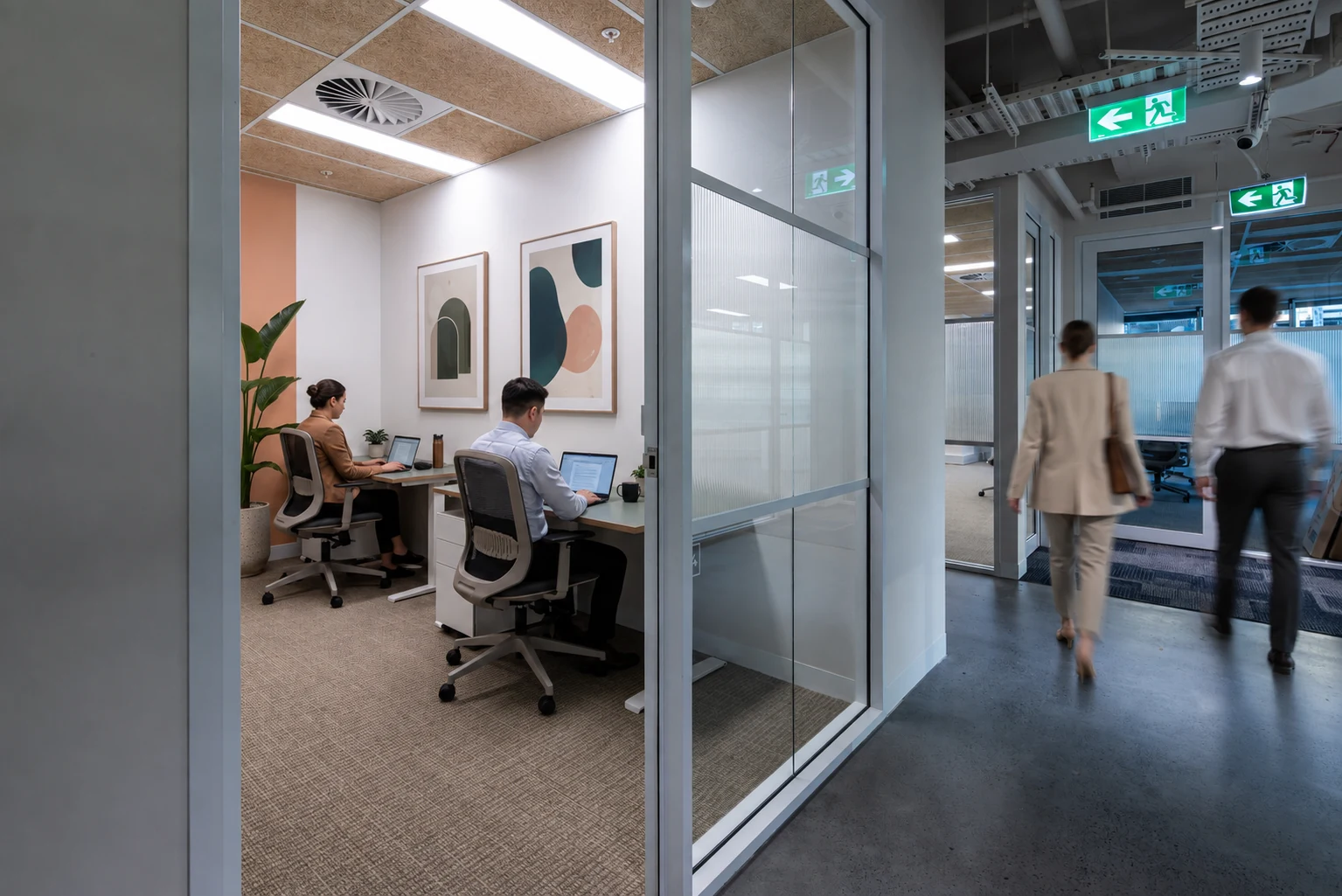
Private offices for startups and SMEs should provide a genuine boundary between your organisation and the wider workspace community.
Ask:
- Is the office lockable and accessible only to our team?
- What access control and visitor-management systems are used?
- Are there private rooms for confidential calls?
- How is internet traffic separated and secured?
- What CCTV, alarm and after-hours security measures are in place?
- Can we install additional technology or security controls if required?
5. Which shared facilities can our team use?
One of the largest advantages of a flexible office is access to more than the area inside your office walls.
Shared meeting rooms, boardrooms, lounges, kitchens, wellness facilities, event spaces and breakout areas can give a smaller business the amenity of a much larger workplace. They can also improve employee experience by giving people a choice of settings throughout the day.
The key question is not only what exists, but how reliably your team can access it. A spectacular boardroom has limited value if it is always booked.
Ask:
- Which shared facilities are included in our membership?
- How far in advance can rooms be booked?
- Are monthly meeting-room credits provided?
- What happens when shared spaces reach capacity?
- Can we host events, workshops or client functions onsite?
- Are end-of-trip, wellness or hospitality facilities available?
6. What employee experience will the location create?
An office must work for the people expected to use it.
Consider public transport, parking, cycling access, surrounding food options and the quality of the arrival experience. Inside the workspace, assess natural light, air quality, acoustics, ergonomics and the availability of quiet areas.
For hybrid teams, the office competes with the convenience of home. It needs to offer something better: stronger collaboration, professional support, useful amenity and a sense of momentum.
Ask:
- How accessible is the location by public transport and bicycle?
- Are ergonomic furniture and sit-to-stand options available?
- Does the workspace offer quiet, collaborative and social zones?
- How are comfort, cleaning and maintenance managed?
- Is the building accessible for people with disability?
- What hospitality or wellness services are available?
7. What services are available day to day?
Serviced offices should reduce operational friction. The provider should take care of the workplace fundamentals so your team can focus on the business.
Ask who manages reception, mail, visitors, maintenance, IT issues and room bookings. Find out whether support is delivered by a consistent onsite team or through a remote help desk.
This distinction matters. A responsive local team can solve small issues before they become distracting ones and can create a more polished experience for clients and employees.
Ask:
- Is there an onsite team during business hours?
- Who greets guests and manages deliveries?
- What level of IT support is included?
- How quickly are maintenance issues addressed?
- Can the team assist with meetings or events?
- Are food, beverage or catering services available?
8. Will the workspace strengthen our culture and community?
Privacy matters, but isolation rarely helps a growing business.
A well-managed flexible workspace can create valuable proximity to founders, operators, professional advisers and potential partners. Community events and informal introductions may support learning, referrals and collaboration. The benefit comes from relevance and consistent engagement, not simply having many businesses under one roof.
Ask how the provider builds its community and whether participation is optional. Your team should be able to connect when useful and concentrate when it is time to execute.
Ask:
- What types of businesses work from the location?
- How does the onsite team introduce and connect members?
- What professional, social or educational events are offered?
- Are there opportunities to promote our business within the network?
- Can our team use the space without participating in community activities?
9. Can the office represent our brand professionally?
Your office is part of your market presence. It shapes the first impression made on candidates, customers, investors and partners.
Ask how much freedom you have to personalise the space. Some providers allow signage, branded screens, custom layouts and furniture changes, while others maintain a standardised environment.
The shared areas matter too. Reception, meeting rooms, amenities and hospitality should reflect the standard your business wants to project.
Ask:
- Can we add signage or branding inside the office?
- Can the layout and furniture be adjusted?
- Is our business listed at reception or in the building directory?
- Can we use the location as our registered business address?
- Are meeting rooms suitable for important client presentations?
10. How flexible are the agreement terms?
Flexibility should exist in the contract, not only in the sales language.
Review the minimum term, notice period, renewal process and conditions for changing office size. Understand what is required upfront and what happens at the end of the agreement.
Your ideal term will depend on your stage. A young startup may value maximum agility, while a more established team may exchange a longer commitment for price certainty or a customised office.
Ask:
- What is the minimum commitment?
- How much notice is required to leave or change offices?
- What deposit, bond or security is required?
- Can the agreement be transferred to another location?
- How do renewals and price changes work?
- Are there make-good obligations at the end of the term?
11. How reliable is the technology infrastructure?
Fast internet is now the baseline. The real test is resilience, support and suitability for your work.
Ask about connection speeds, redundancy, Wi-Fi coverage, private networks and support response times. If your team relies heavily on video calls, cloud platforms or large file transfers, test the service during the tour.
Also check the technology inside meeting rooms. Screens, video conferencing, audio and simple wireless connectivity can determine whether hybrid meetings run smoothly or become a weekly endurance event.
Ask:
- What upload and download speeds are available?
- Is there a redundant internet connection?
- Can we establish a private network or dedicated connection?
- What meeting-room technology is included?
- Who provides technical support, and during which hours?
12. What proof is there that the workspace performs well?
A strong provider should be able to explain how it supports businesses after move-in.
Ask to speak with current members whose team size or working model resembles yours. Look for consistency in service, cleanliness, technology, community management and issue resolution.
If possible, return for a second visit during a busy period. A workspace can feel very different at 11 am on a Tuesday than it does during a quiet Friday afternoon tour.
Ask:
- Can we speak with a current member?
- What is the typical member retention period?
- How are feedback and service issues handled?
- Can we trial the workspace before committing?
- Can we visit during a peak attendance period?
A practical way to compare flexible private offices
Create a simple scorecard before touring providers. Weight each category according to what matters most to your business:
- Scalability and agreement flexibility
- Total monthly occupancy cost
- Hybrid work support
- Privacy and security
- Included amenities and services
- Location and employee experience
- Technology reliability
- Brand presentation
- Community and network value
Score every option against the same criteria. This keeps the decision grounded when one impressive feature threatens to distract from a poor overall fit. Think of it like building a team: one star player does not compensate for weaknesses across every other position.
Choose an office that can move with your business
The best flexible private offices do more than provide desks behind a closed door. They give growing teams privacy, professional infrastructure and access to shared amenity without locking the business into a rigid workplace model.
When comparing flexible private offices in Australia, focus on how the space will operate through change. Test the scalability, understand every cost, examine the hybrid experience and confirm that the provider can support your people day after day.
CorporateCubes.Co creates flexible, fully supported private offices for ambitious teams seeking a professional base with room to grow. From dedicated offices and meeting rooms to shared business lounges, event spaces and onsite support, our workspaces are designed to help businesses perform at their best.
Ready to find a private office built around your team? Tour CorporateCubes.Co locations or book a tour today.
FAQs
What is a flexible private office?
A flexible private office is a secure, dedicated workspace supplied under a more adaptable agreement than a conventional commercial lease. It commonly includes furniture, internet, utilities, cleaning and access to shared facilities such as meeting rooms, kitchens and business lounges.
How are flexible private offices different from serviced offices?
The terms often overlap. Both generally provide ready-to-use offices and operational services. Flexible private offices place particular emphasis on adaptable terms, the ability to scale and access to shared workspace amenities. The exact inclusions vary by provider, so compare the complete offer rather than relying on the label.
Are flexible private offices suitable for startups?
Yes. Flexible private offices can help startups establish a professional base without funding an entire fitout or entering a long conventional lease. They can also provide room to expand, access to meeting facilities and an established business community.
Can a flexible private office support a hybrid team?
Yes, provided the workspace offers the right mix of dedicated desks, shared areas, meeting rooms and flexible access. Ask how the provider manages peak attendance days and whether employees can use business lounges or other locations when required.
What amenities are usually included?
Common inclusions are furniture, internet, utilities, cleaning, reception services, kitchens and access to shared spaces. Meeting rooms, printing, storage, parking, event areas and wellness facilities may be included, credited monthly or charged separately.
Are flexible private offices secure?
They can be highly secure, but standards differ. Check for lockable offices, controlled building access, visitor management, CCTV, secure internet options and private areas for confidential conversations.
How much do flexible private offices cost in Australia?
Pricing depends on the city, location, office size, agreement length, included services and level of amenity. Compare the total occupancy cost, including any meeting-room charges, printing, parking, deposits and establishment fees, rather than relying only on the advertised rate.
How long are flexible office agreements?
Terms vary from short rolling arrangements to multi-year agreements. Longer commitments may offer better pricing or greater customisation, while shorter terms provide more agility. Confirm the minimum term, notice period, renewal conditions and options to change office size.
Can we brand or customise a flexible private office?
Many providers permit internal signage, branded screens, layout changes or selected furniture options. The degree of customisation depends on the building and agreement, so confirm what is possible before signing.
What should we inspect during a private office tour?
Inspect the office size, acoustics, natural light, furniture, internet performance, access control and proximity to shared amenities. Visit meeting rooms, kitchens, lounges and end-of-trip facilities. If possible, tour during a busy period to see how the workspace performs at peak occupancy.